Why the First Five Minutes Matter
When someone reaches out in crisis, every second of silence can deepen the sense of despair. Research consistently shows that the first five minutes of a crisis call are critical, they are the moments when a compassionate, live responder can interrupt spiraling thoughts, calm intense emotion, and begin to restore hope.
A 2022 study in Psychiatric Services reviewed outcomes from national crisis hotlines and found that distress and suicidal ideation often decrease during the call itself (Gould et al., 2022). In other words, the conversation itself becomes an intervention, and that intervention begins the moment a trained responder says, “I’m here for you.”
Timely response is not simply an operational metric; it is a life-saving act. According to the Substance Abuse and Mental Health Services Administration (SAMHSA, 2024), speed to answer and abandonment rate are two of the most important quality measures for crisis lines nationwide. When callers are left waiting, many will hang up before help arrives. Those who do reach someone, however, often experience immediate relief. Within the first few minutes, their anxiety levels drop, and they begin to think more clearly about next steps.
Empathy in those first moments is equally vital. Studies of crisis counselors show that a warm tone, validation, and genuine care predict the caller’s willingness to stay on the line and accept help (Mishara et al., 2016). By contrast, automated systems, cold transfers, or long delays can reinforce a sense of abandonment.
At the Foundation for Christian Counseling’s (FFCC) 24/7 Crisis Helpline, we understand the urgency of every call. This vital ministry is the cornerstone of our Concepts of Truth outreach—an intentional, proactive effort to reach those in our communities who are struggling with mental health and addiction issues.
Here’s how it works: our staff collaborate daily with pastors, business leaders, and community partners such as pregnancy centers and local health providers. These trusted partners often stand at the crossroads of crisis, where people turn for help in moments of desperation. The Helpline equips them with a direct, faith-based resource available around the clock—ensuring that no one has to face crisis alone.
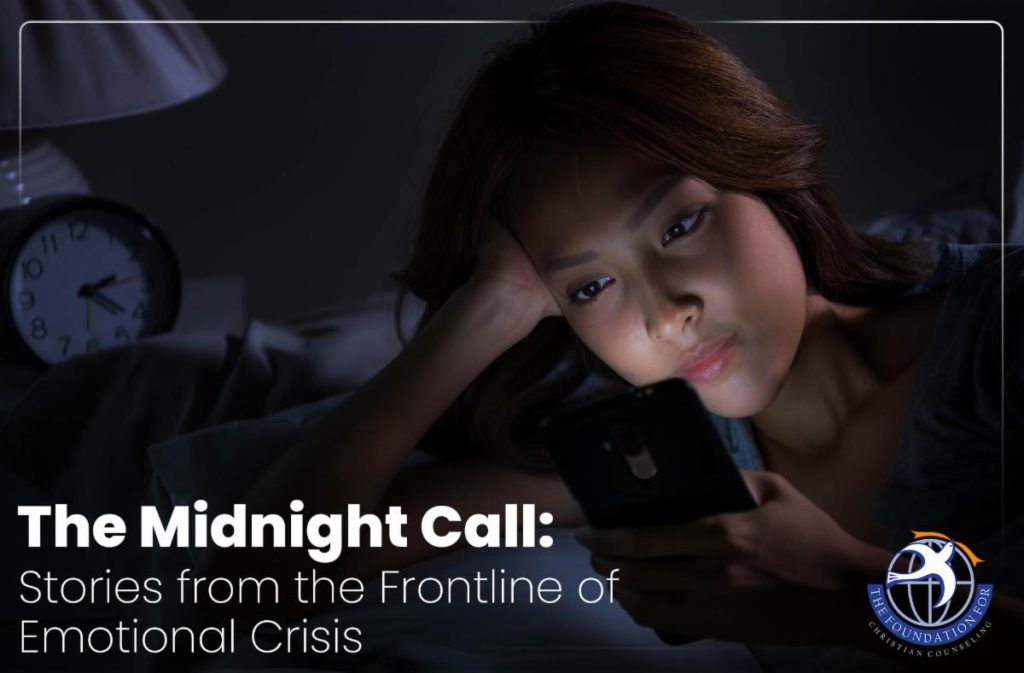
This life-saving connection is only possible through the generosity of our Donors, whose gifts sustain the Helpline’s 24/7 availability. Every answered call affirms the value of life and the power of compassion. When people call the church or another trusted community resource, their cries for help no longer go unanswered. Through the 24/7 Helpline, those calls are met within the first five minutes by a compassionate voice that listens, prays, and responds in real time. This makes all the difference. Nearly one-third of our calls come after midnight, a time when most ministries and organizations are unable to respond. Yet through the generosity of our donors, the Helpline stands ready, ensuring that even in the darkest hours, no one faces their crisis alone.
At the Foundation for Christian Counseling’s 24/7 Crisis Helpline, we see this truth every day. A mother calling in tears at 2 a.m., a veteran wrestling with hopelessness, a teen on the edge — what matters most is not a polished script, but the immediate presence of another human being who listens, prays, and cares. That live, compassionate voice in the first five minutes can be the bridge between isolation and hope.
That is why donor support matters. Your partnership ensures that no one faces those first five minutes alone — that every call is met with a voice of compassion, and every moment of crisis becomes an opening for healing and faith to break through.
📚 References
- Gould, M. S., Lake, A. M., Munfakh, J. L. H., & Kleinman, M. (2022). Evaluation of crisis hotlines: Outcomes and implications for best practices. Psychiatric Services, 73(5), 459–466. https://doi.org/10.1176/appi.ps.20220294
- Mishara, B. L., Chagnon, F., Daigle, M., Balan, B., Raymond, S., Marcoux, I., Bardon, C., Campbell, J. K., & Berman, A. (2016). Which helper behaviors and intervention styles are related to better short-term outcomes in telephone crisis intervention? Suicide and Life-Threatening Behavior, 46(6), 670–683. https://doi.org/10.1111/sltb.12251
- Substance Abuse and Mental Health Services Administration (SAMHSA). (2024). 988 Suicide and Crisis Lifeline: Performance metrics and standards. https://www.samhsa.gov/mental-health/988/performance-metrics
KFF (Kaiser Family Foundation). (2024). The 988 Suicide and Crisis Lifeline: Two years after launch. https://www.kff.org/mental-health/issue-brief/988-suicide-crisis-lifeline-two-years-after-launch
About the Author