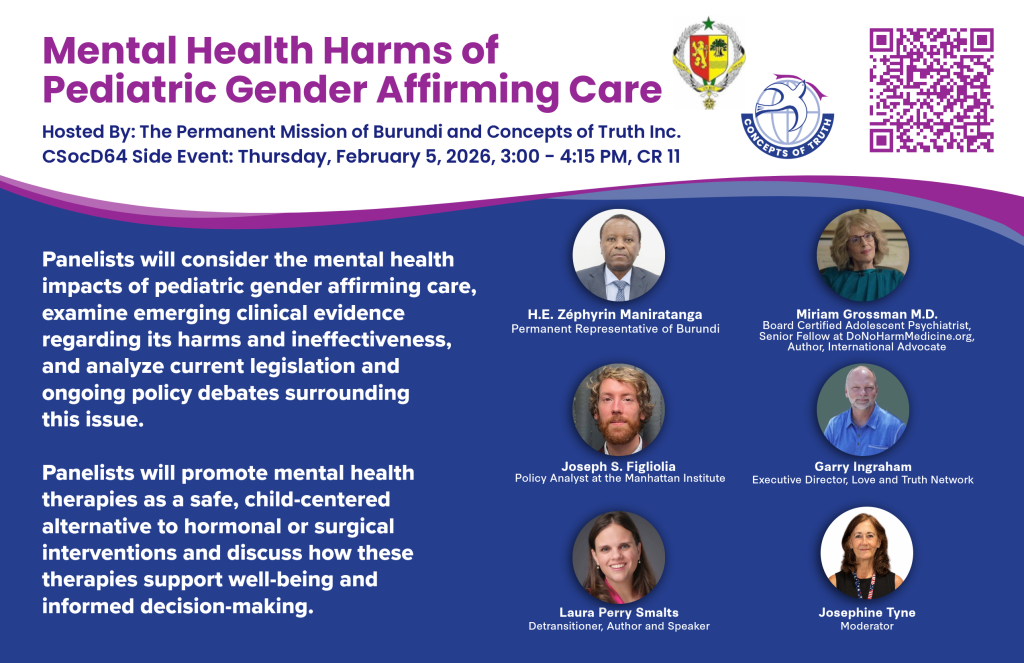
Mental Health Harms of Pediatric Gender Affirming Care
Do you want a happy little boy or a dead little girl?
This is the kind of question that professionals present to parents of confused adolescents to encourage them to accept harmful “gender affirming care.” The question is itself a logical fallacy called bifurcation: an error in reasoning that presumes that only two options exist when in reality there are more options. Parents and adolescents need to know the truth about the harms and ineffectiveness of gender affirming care and the benefits of psychological treatment options. Unfortunately, the truth is suppressed because for those who stand to benefit economically from extreme medical interventions, the truth is a threat. We urge Member States to advance social development by exposing the truth about gender affirming care and ensuring access to alternative mental health therapies that will promote mental health and well-being.
Concepts of Truth, Inc. is a faith-based NGO supporting families in mental and sexual health through professional counseling, a 24/7 international crisis helpline that has served over 20,000 callers, counselor training, abortion recovery, and a sexual health curriculum for schools. Concepts of Truth supports the pillars of the Geneva Consensus Declaration seeking to advance women’s health, protect families, and preserve life at all stages.
“Gender Affirming Care” Defined
According to the World Health Organization, the phrase “gender affirming care” refers to interventions designed to support and affirm transgender individuals who do not identify as their biological sex and thus experience “gender incongruence.” Gender incongruence is a person’s disordered view of their own biological reality. Such confusion naturally leads many individuals to suffer distress; professionals call this distress “gender dysphoria” (Merck Manual, n.d.). Although the vast majority of pediatric gender dysphoria cases resolve on their own (Rawee, 2024), puberty blockers, masculinising / feminizing hormones, and surgeries have increasingly become the first line of pediatric treatments (Cass, 2024).
Gender Affirming Care Does Not Improve Mental Health Outcomes And Causes Harm
There is simply no evidence demonstrating that gender-affirming care provides health benefits to minors with gender dysphoria (Cass, 2024; McDeavitt, 2025; U.S. Department of Health and Human Services [HHS], 2025; U.S. v. Skrmetti, 2024). Neither puberty blockers nor masculinizing/feminizing hormones nor surgeries have ever even been rigorously tested as a treatment for pediatric gender dysphoria (Cass, 2024; HHS, 2025; McDeavitt, 2025; U.S. v. Skrmetti, 2024). Conversely, rigorous systematic reviews and meta-analyses have discredited the view that pediatric gender affirming treatments significantly improve mental health outcomes such as depression, anxiety or suicide (Cass, 2024; HHS, 2025; McDeavitt, 2025; U.S. v. Skrmetti, 2024). This reality has led some researchers to contend that “it is ethically problematic to view the routine use of hormonal or surgical interventions in youth with gender dysphoria as evidence-based” (Gorin, 2025).
Emerging research demonstrates that commonly-prescribed hormone treatments carry significant risks of irreversible harm (Jorgensen, 2024). These harms include infertility/sterility, sexual dysfunction, psychiatric disorders, adverse cognitive impacts, stroke, myocardial infarction, metabolic disorders, surgical complications, impaired bone density, and regret (HHS, 2025; U.S. v. Skrmetti, 2024). As a result, in March 2024, the United Kingdom’s Commission on Human Medicines concluded that there is an unacceptable safety risk in the continued prescription of puberty blockers for children and indefinitely halted treatments for minors (Cass, 2024). Other countries have followed suit and prioritized psychological treatments, however most countries continue to allow gender affirming care treatments without any restrictions, including for minors (Equaldex, 2025).
Evidence Regarding Benefits of Gender Affirming Care Has Been Distorted
Adolescents with gender dysphoria and their loved ones struggle in vain to find answers (Post Trans, 2025). Notwithstanding the pages of computer-search results to the contrary, research touting the benefits of gender affirming care is minimally unreliable: in many cases, harms were not tracked; claims of mental health benefits were not substantiated; contrary data was not reported; research papers were falsified; and unfavorable results were suppressed (McDeavitt, 2025; Mason, 2022; Regnerus, 2019; U.S. v. Skrmetti, 2024). In the U.S. these practices have led to a congressional probe (The Hill, 2024). Equally disturbing, researchers, academics, and medical professionals who have tried to challenge gender transition treatments frequently faced ferocious and coordinated attacks, including acts of professional intimidation and actual violence (McDeavitt, 2025).
Psychological Treatments: The Suppressed Alternative
Children who complain of gender dysphoria typically also have other psychological vulnerabilities; a significant number have histories of trauma, psychosis, depression, anxiety, and sexual abuse (American College of Pediatricians, 2024; Cass, 2024; HHS, 2025; Rawee, 2024; U.S. v. Skrmetti, 2024). Psychological therapies have resulted in documented successes in treating both co-existing mental health issues as well as gender dysphoria with no harmful medical consequences (American College of Pediatricians, 2024; Cass, 2024; HHS, 2025; Rawee, 2024).
Sadly, clinicians rarely conduct mental health evaluations beyond acknowledging the patient’s own subjective self-reporting of gender dysphoria (Bechard, 2016). Meanwhile, advocates of gender affirming hormonal and surgical interventions have accused mental health professionals who recommend mental health therapies as being “anti-science” and engaging in “conversion therapy” (McDeavitt, 2025; Reed, 2022). Certain transgender activists even brought formal licensure complaints against therapists simply for engaging transgender patients in exploratory talk therapy, denouncing them as conversion therapists with “sinister” goals (McDeavitt, 2025). As Professor Kathleen McDeavitt, M.D. observes, clinicians in the U.S. and abroad have been silenced, bullied, scapegoated and demonized for criticizing what they viewed as rushed, invasive gender affirming care interventions driven by activist interests and rigid ideology rather than medical judgment (McDeavitt, 2025).
Many transitioned patients realized after the fact that their gender dysphoria had been caused by preexisting mental health conditions and lamented that the process of transitioning prevented them from dealing with their underlying mental health problems (Littman, 2021). Many detransitioners wished their doctors or therapists had more fully discussed mental health factors before proceeding to medically transition (Respaut, 2022). Unfortunately, whistleblowers and detransitioners who have tried to draw public attention to the risks and harms associated with pediatric gender transition have been marginalized and many reported harassments (Post Trans, 2025).
Vulnerable individuals, particularly confused girls and their parents, are being manipulated to consent to unnecessary, harmful and potentially irreversible medical interventions. These discredited interventions deprive adolescents of the opportunity to make informed decisions and foreclose critical options in adulthood, such as the option to have biological offspring and have normal sexual function (Jorgensen, 2024). Disregarding biological sex as a defining marker exposes women to increased exploitation and negatively affects their healthcare (Alsalem, 2025). Girls should be affirmed to be confident in their biological sex, consistent with their humanity and the dignity and value of their bodies, and they should be provided with mental health resources to address underlying psychological vulnerabilities.
Recommendations
- Ensure that children who report an experience of gender incongruence or dysphoria receive comprehensive mental health assessments and treatments at the outset to properly address underlying factors;
- Prohibit hormonal or surgical interventions to alter a child’s biological sex;
- Ensure that children who seek to transition are provided full information about its harms and ineffectiveness;
- Protect the right of children to receive appropriate direction and guidance from their parents in all matters affecting their health and well-being, recognizing that parents are best placed to act in the best interests of their children, in full accordance with international human rights law.
References
Alsalem, R. (2025). Sex-based violence against women and girls: New frontiers and emerging issues. United Nations Human Rights Council.
American College of Pediatricians. (2024). Mental health in adolescents with gender incongruence. https://acpeds.org
Bechard, M. (2016). Psychosocial and psychological vulnerability in adolescents with gender dysphoria. Journal of Sex & Marital Therapy, 42(7), 523–534. https://doi.org/10.1080/0092623X.2015.1113580
Cass, H. (2024). Independent review of gender identity services for children and young people: Final report. NHS England. https://www.england.nhs.uk
Equaldex. (2025). Gender-affirming care by country. https://www.equaldex.com
Gorin, M. (2025). Toward evidence-based and ethical pediatric gender medicine. JAMA. https://doi.org/10.1001/jama.2025.xxxxx
(Note: DOI to be confirmed once final issue metadata is available.)
Jorgensen, S. (2024). Puberty suppression for pediatric gender dysphoria. Archives of Sexual Behavior, 53, 1–14. https://doi.org/10.1007/s10508-024-0xxx-x
(Exact pagination/DOI to be confirmed.)
Littman, L. (2021). Individuals treated for gender dysphoria: Characteristics and outcomes. Archives of Sexual Behavior, 50(7), 3353–3369. https://doi.org/10.1007/s10508-021-02088-w
Mason, J. (2022, August 17). Dubious transgender science. The Wall Street Journal. https://www.wsj.com
McDeavitt, K. (2025). Pediatric gender-affirming care is not evidence-based. Current Sexual Health Reports. https://doi.org/10.1007/s11930-025-0xxx-x
(DOI to be confirmed.)
McDeavitt, K. (2025). Citation issues in the American Academy of Pediatrics policy statement. Archives of Sexual Behavior. https://doi.org/10.1007/s10508-025-0xxx-x
(DOI to be confirmed.)
Merck Manual. (n.d.). Gender dysphoria. https://www.merckmanuals.com
Post Trans. (2025). Gender detransition: A path toward self-acceptance. https://post-trans.com
Rawee, P. (2024). Development of gender non-contentedness. Archives of Sexual Behavior. https://doi.org/10.1007/s10508-024-0xxx-x
(Exact DOI to be confirmed.)
Reed, E. (2022, December 20). “Gender exploratory therapy”: A new anti-trans conversion therapy. The New York Times. https://www.nytimes.com
Regnerus, M. (2019). New data show “gender-affirming” surgery doesn’t really improve mental health. Public Discourse. https://www.thepublicdiscourse.com
Respaut, R. (2022, December 22). Why detransitioners are crucial to the science of gender care. Reuters. https://www.reuters.com
Senate Republicans launch inquiry into pediatric gender medicine. (2024, December 6). The Hill. https://thehill.com
U.S. Department of Health and Human Services. (2025). Treatment for pediatric gender dysphoria: Review of evidence and best practices. https://www.hhs.gov
U.S. v. Skrmetti. (2024). Corrected brief of amici curiae of the American College of Pediatricians et al. Supreme Court of the United States.
World Health Organization. (n.d.). Gender incongruence. https://www.who.int