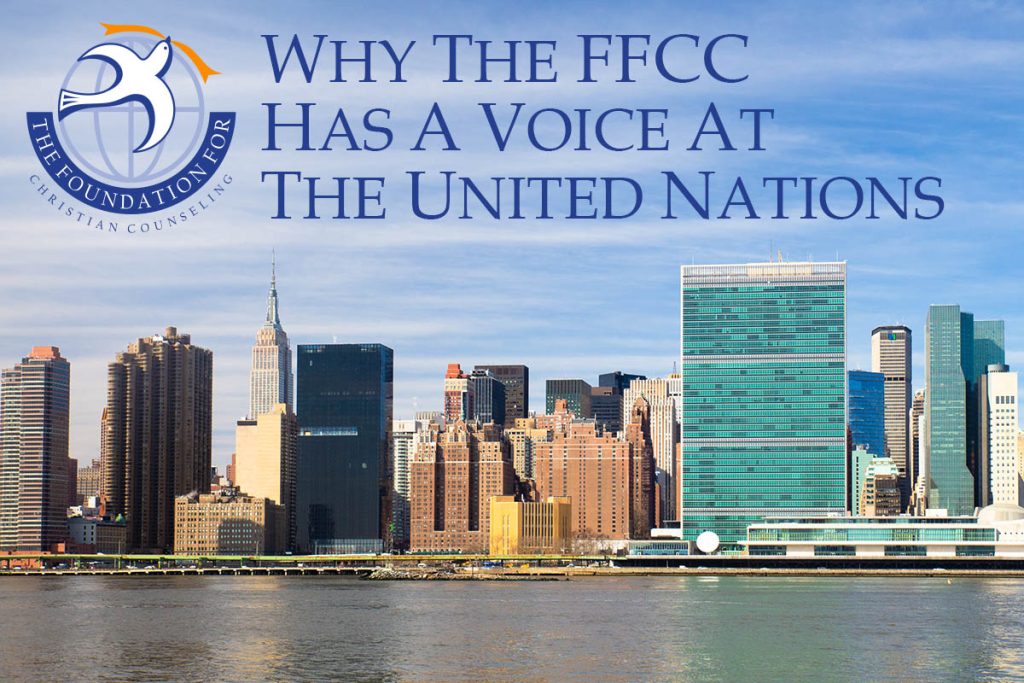
Why the FFCC Has a Voice at the United Nations
Protecting Children and Strengthening Families Shapes a Healthier and Safer Society
Advocating for life and family at Foundation for Christian Counseling (FFCC) begins with a conviction rooted in Christian faith that all life is sacred. Therefore, every life is important and is made in the reflection of our Creator. This spiritual truth is demonstrated in the functional reality confirmed by decades of clinical and social research: healthy individuals are most often formed within healthy families. When families are supported, children thrive. When families weaken, communities and social systems are forced to absorb the cost.
This truth and unfolding reality shape everything the FFCC does, from our passion to provide access to counseling services and parenting programs to crisis response and prevention initiatives. It is also the reason FFCC engages beyond individualized interventions at the local level by participating in global advocacy efforts at the United Nations.
Why the United Nations Matters to Families and Children
The United Nations (UN) plays a significant role in shaping international trends related to children’s rights, education, healthcare, and family life. While the UN resolutions and declarations are often framed as aspirational, they regularly influence national policies, funding priorities, educational standards, and social service frameworks.
Over time, these global norms filter down into local communities, affecting schools, healthcare systems, family services, and even the expectations placed on parents. In this sense, global policy conversations have local consequences.
FFCC’s engagement at the UN in New York City reflects a commitment to advocate in places where faithful Christian voices lift up spiritual truths in the gateways and high places of the world (such as the UN). By doing this, we take important steps to ensure that children’s well-being remains connected to family stability, parental responsibility, and the inherent dignity of human life.
Strong Families Reduce Downstream Social Costs
One of the most compelling reasons to advocate for life and family values, locally and globally, is their measurable impact on community health.
Research consistently shows that strong families correlate with:
- Lower rates of substance abuse (Alexander et al., 2023; Pinquart, 2025; Van Ryzin et al., 2016)
- Reduced crime and incarceration (Apel, 2008; Bloome, 2017; Johnston et al., 2025)
- Lower school failure and dropout rate (Jeynes, 2024; Karhina et al., 2023)
- Decreased healthcare utilization and improved long-term health outcomes (Bzostek & Beck, 2011; Gaydosh et al., 2018; Lut et al., 2021)
- Stronger workforce participation and economic stability
(Bloome, 2017; Chetty et al., 2014; Johnston et al., 2025)
These outcomes are not accidental. Families are the primary setting where children learn emotional regulation, responsibility, moral reasoning, and resilience. Parenting is not merely a private activity; it is the earliest and most effective form of prevention.
When families are undermined, the cost does not disappear. It shifts downstream to schools, courts, hospitals, and social service systems. From both a humanitarian and fiscal perspective, investing in families is one of the most effective ways to reduce long-term social harm.
Cultural Trends That Undermine Family Stability
In recent years, many international policy discussions, including those taking place at the United Nations, have reflected cultural trends that raise serious concerns for children and families. These trends often include:
- A diminishing emphasis on parental authority and responsibility
- Redefinitions of family and childhood that detach children from stable caregivers
- Ideological approaches to identity and sexuality that bypass parental guidance and developmental safeguards
When parental roles are weakened and family structure is treated as secondary, children are left more vulnerable, not more protected. Stability, consistency, and guidance are essential for healthy development, particularly during childhood and adolescence.
It is worth noting that even the current U.S. administration has acknowledged concerns related to the United Nations, including the politicization of human rights mechanisms and the disconnect between its international declarations and real-world outcomes that often defy common sense. These concerns highlight an important reality: global institutions are influential, but they require engaged and responsible voices to help shape their priorities that benefit families and society at large.

Why Christian Engagement on an International Level Matters
Christian concern for children and families must extend beyond local communities. It must include presence and participation where influences are formed and have a widespread impact. Engagement at the international level allows advocates to address problems upstream, before harmful ideas become embedded in systems that affect millions.
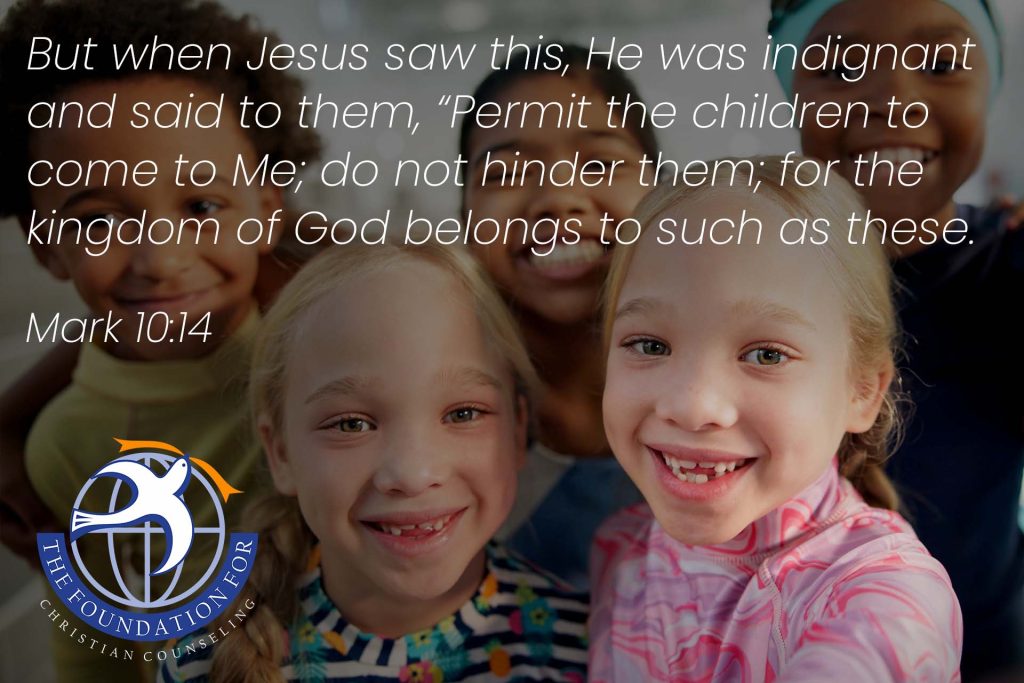
This is not about politics. It is about stewardship and moral responsibility. It’s about protecting the children. Scripture consistently affirms that protecting children is not optional but central to God’s kingdom purposes.
FFCC’s Advocacy Through Concepts of Truth International
Through its program Concepts of Truth International, the FFCC participates in annual advocacy efforts at the United Nations focused on:
- Protecting children
- Affirming the dignity and sanctity of life
- Upholding the foundational role of family and parental responsibility
This work ensures that faith-informed, family-centered perspectives remain present in global discussions that often exclude them. Concepts of Truth International is accredited at the United Nations, serving as a bridge between global advocacy and local impact, aligning international engagement with FFCC’s counseling, parenting, and prevention programs.
Why Supporting This Work Matters
For donors and partners, supporting FFCC’s advocacy efforts extends impact beyond immediate services. It helps shape the cultural and policy environments that influence larger systems that, in turn, impact family life at home.
In a world where ideas travel quickly from global institutions to local communities, FFCC’s presence at the United Nations helps ensure that faith-informed wisdom and values are not absent from the conversation.
Strengthening families is not only a moral imperative but also one of the most effective strategies for building healthier communities and a more stable society.
References
Alexander, A. C., Hicks, B. M., Durbin, C. E., & Iacono, W. G. (2023). Parental monitoring and substance use across adolescence: A genetically informed longitudinal study. Journal of Studies on Alcohol and Drugs, 84(2), 230–241. https://doi.org/10.15288/jsad.2023.84.230
Apel, R. (2008). The effects of family structure on parents’ criminogenic exposure. Criminology, 46(4), 967–999. https://doi.org/10.1111/j.1745-9125.2008.00135.x
Bloome, D. (2017). Childhood family structure and intergenerational income mobility in the United States. Demography, 54(2), 541–569. https://doi.org/10.1007/s13524-017-0564-4
Bzostek, S. H., & Beck, A. N. (2011). Familial instability and young children’s physical health. Social Science & Medicine, 73(2), 282–292. https://doi.org/10.1016/j.socscimed.2011.04.014
Chetty, R., Hendren, N., Kline, P., & Saez, E. (2014). Where is the land of opportunity? The geography of intergenerational mobility in the United States. The Quarterly Journal of Economics, 129(4), 1553–1623. https://doi.org/10.1093/qje/qju022
Gaydosh, L., Belsky, D. W., Domingue, B. W., Boardman, J. D., & Harris, K. M. (2018). Father absence and accelerated reproductive development in non-Hispanic white women in the United States. Demography, 55(4), 1245–1267. https://doi.org/10.1007/s13524-018-0696-1
(Note: This and related work link family instability to long-term physiological and health risk markers.)
Jeynes, W. H. (2024). Parental involvement and students’ academic outcomes: A meta-analysis. Educational Psychology Review, 36, Article 9. https://doi.org/10.1007/s10648-023-09778-1
Karhina, K., McMullin, P., & Bastaits, K. (2023). Family transitions and early school leaving in adolescence. Journal of Family Issues, 44(11), 3143–3167. https://doi.org/10.1177/0192513X221126180
Lut, I., Desmond, M., & Tach, L. (2021). Children’s health and family structure: A review of evidence. Journal of Family Theory & Review, 13(4), 465–482. https://doi.org/10.1111/jftr.12436
Pinquart, M. (2025). Parental monitoring and adolescent substance use: A meta-analysis. Journal of Adolescence, 101, 1–14. https://doi.org/10.1016/j.adolescence.2024.101
Regnerus, M. (2012). How different are the adult children of parents who have same-sex relationships? Findings from the New Family Structures Study. Social Science Research, 41(4), 752–770. https://www.sciencedirect.com/science/article/pii/S0049089X12000610
Regnerus, M. (2012). Parental same-sex relationships, family instability, and subsequent life outcomes for adult children: Answering critics of the new family structures study with additional analyses. Social Science Research, 41(6), 1367–1377. https://doi.org/10.1016/j.ssresearch.2012.08.015
Van Ryzin, M. J., Roseth, C. J., Fosco, G. M., Lee, Y., & Chen, I. C. (2016). A component-centered meta-analysis of family-based prevention programs for adolescent substance use. Clinical Psychology Review, 45, 72–80. https://doi.org/10.1016/j.cpr.2016.03.007
About the Author