The Gift of Joy
Gifts and Gift Giving
As we light the third candle of Advent, the Candle of Joy, we pause to reflect on the true nature of joy, revealed not in what we receive, but in the gift God has given to the world in Jesus Christ.
When is a gift truly a gift? There may be several answers, but here are just a few. A true gift is one that costs the giver something; it’s one freely given – no strings attached; it’s one that has no thought of receiving something in return; it’s one given with thought for what the recipient needs. I knew someone who had a closet full of random items they picked up while traveling. When an occasion merited a gift, they would pull an item out of the closet and ship it. I have received throw pillows, previously owned soup bowls, an oddly shaped metal serving thing… Although I appreciated being remembered, these random, odd gifts seemed somehow out of context for my life.
Did you know that National Re-gifting Day is held each year on the Thursday before Christmas? That means this year it is on December 18. Here are a few re-gifting stories: One lady bought her brother and new sister-in-law a food processor for their June wedding. And then at Christmas, she got the same food processor, complete with dried still on it. She donated it to Goodwill. Another regifting victim is a woman who got a purse from her mother-in-law for Christmas. But when she opened it, she found an old appointment book still in it. One final story: this one is pretty bad. An elderly aunt gave her niece a box of chocolate for Christmas, but when the niece took a bite of one… it was like chocolate dust. She noticed the box had an expiration date from the 70′s.

Gift Givers
The modern-day practice of gift-giving at Christmas traces its origins to Saint Nicholas of Myra, a 4th-century Greek bishop known for his generosity and kindness, particularly to children and the poor. Born around 280 A.D. in modern-day Turkey, he used his inherited wealth to help others. His actions were almost certainly a reflection of the original gift-givers of Christmas, the wise men, or Magi. The word magi is a borrowed word from the Persian language, meaning “great ones”.
It is not clear exactly who they were, but they were most likely scholars of some kind. That is clear because they studied the stars and believed they had an influence on human affairs. It’s also clear they were men of substance and independence; their journey was likely several hundred miles long, involving months of travel requiring provision for themselves, their animals, and a retinue of attendants, not to mention the extravagance of the gifts they brought for the newborn king.
What is clear about the Magi is that they were men willing to sacrifice their time, treasure, and comfort to see the newborn King of the Jews in person.
Gifts
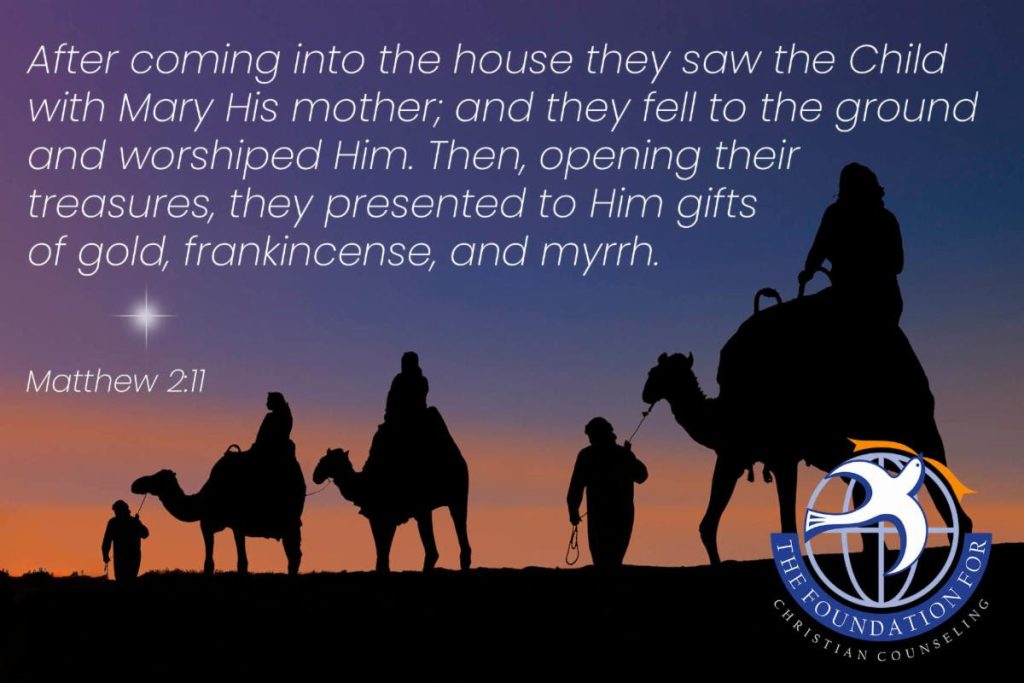
Matthew 2:11 says, “On coming to the house, they saw the child with his mother Mary, and they bowed down and worshiped him. Then they opened their treasures and presented him with gifts of gold and of incense and of myrrh.” Let’s briefly unpack these gifts.
Gold has been a standard of wealth for millennia; In that day, gold was most often associated with royalty. The average person had no usual means of obtaining gold. Bringing a gift of gold was acknowledging the kingship of Jesus.
Frankincense and myrrh are mentioned several times in Scripture. Both were used in the sacred anointing oil for the tabernacle. They are mentioned in Exodus 30:34-35 and, once blended, were considered sacred to the Lord, used only in the Tabernacle and later in the First and Second Jerusalem Temples, where they were offered on a specialized incense altar.
In addition to being one of the ingredients in the perfume of the sanctuary, it was used as an accompaniment of the meal-offering (Leviticus 2:1, 2:16, 6:15, 24:7). When burnt, it emitted a fragrant odor, and was also an emblem of prayer (Psalm 141:2; Luke 1:10; Revelation 5:8, 8:3). Together, frankincense and myrrh point beyond the manger toward the sacred work Jesus would one day fulfill. This gift points scholars towards recognition of the priestly role the child Jesus would have. These gifts were pointing forward to a great truth: The child Jesus would become both King and Priest, something unheard of among the people of Israel.

The Gift and The Gift Giver
There is an element of irony in the wise men bringing gifts to honor Jesus, who is both the greatest gift and the greatest gift giver. As we contemplate this, it may be helpful to think about it in light of a matryoshka doll, also known as a Russian nesting doll. The name “matryoshka” literally means “little matron”. A set of matryoshkas consists of a wooden figure that separates, top to bottom, to reveal a more petite figure of the same type inside, which, in turn, has another figure inside it, and so on.
Each layer reveals not less joy, but more joy unfolding as we come to understand who Christ is and what He gives.

The birth of Jesus was literally God’s gift to the world, a gift we desperately needed. Jesus, the gift of God, in turn became Jesus the gift-giver. Consider the following. Jesus gave us a New Revelation of God – John 1:1,14. He gave us a New Covenant with God – Jeremiah 31:31; Luke 22:20; I Corinthians 11:25; He gave us a New Birth John 3; I Peter 1:23 leading to people becoming a New Creation – 2 Corinthians 5:17; Galatians 6:15 giving us a New Life – John 1:4; 4:14; 5:24-26; I John 5:11-13 marked by New Hope – Romans 5:2,5; 8:19; 15:12-13; a New Peace – Isaiah 9:6-7; John 14:27; Ephesians 2:14-15 and a New Joy – John 15:9-11; 16:20-24; I Peter 1:8. And this list is not complete, there is so much more.

Gifts and Regifting
As we celebrate this Christmas season, permit me to challenge you about gifts and regifting. In honor of the greatest gift and gift-giver, what gift can we offer Him in return? Jesus was once asked: “Teacher, which is the greatest commandment in the Law?” Jesus replied: “‘Love the Lord your God with all your heart and with all your soul and with all your mind.’ This is the first and greatest commandment. And the second is like it: ‘Love your neighbor as yourself.’ All the Law and the Prophets hang on these two commandments.” (Matthew 22:36-40). Our gift back to God is found in these verses: Love God, love people. That love for Him, shown in loving others, is explained in I Corinthians 13:4-8. Further, some need the gift of our presence, some the gift of our absence; some need the gift of our silence, others the gift of our words. All need the gift of our love and the gift of the good news of the coming of Jesus Christ.
And what about re-gifting? Many of the gifts Christ gives us, we can in turn re-gift to others: forgiveness, mercy, prayer, encouragement, to name a few. These can be given in a variety of ways and in a variety of places. Give of your time and resources to help the least, the last, and the lost. Volunteer at local soup kitchens, homeless shelters, and rescue missions. Consider giving a gift to The Foundation for Christian Counseling, whose mission is to Transform Communities One Family (even one person) at a time.
As we celebrate this Christmas season, remember Christmas without Christ is like a nicely wrapped box given as a present, but with no present inside. It may look beautiful on the outside, but without Christ, it is empty at the core.
About the Author